host a Witness Circle
Most of us already feel that the lives lost to war matter. What’s harder is finding a way to act on that feeling together. A Witness Circle gives you & your community a way in: a meaningful, unhurried hour that turns a private sense of “someone should remember them” into something you do, side by side.
It asks very little of you as host. Everything is prepared: the presentation, a short host’s guide, the questions, the closing act of remembrance, so you don’t need to be an expert or build anything from scratch. You bring the group and the space; we bring the rest.
And it tends to stay with people. Reading one person’s story aloud, sitting in silence, saying names into the room, these are small acts, but groups will leave the conversation feeling closer, and clearer about why recognition is important. It’s a way to deepen the life of your community around something that genuinely matters.
What happens in a circle
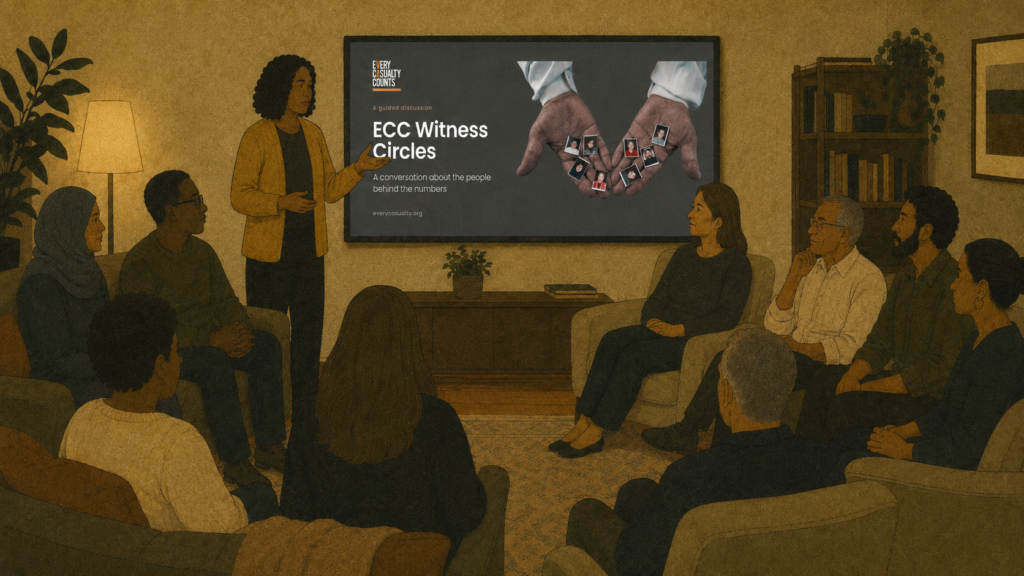
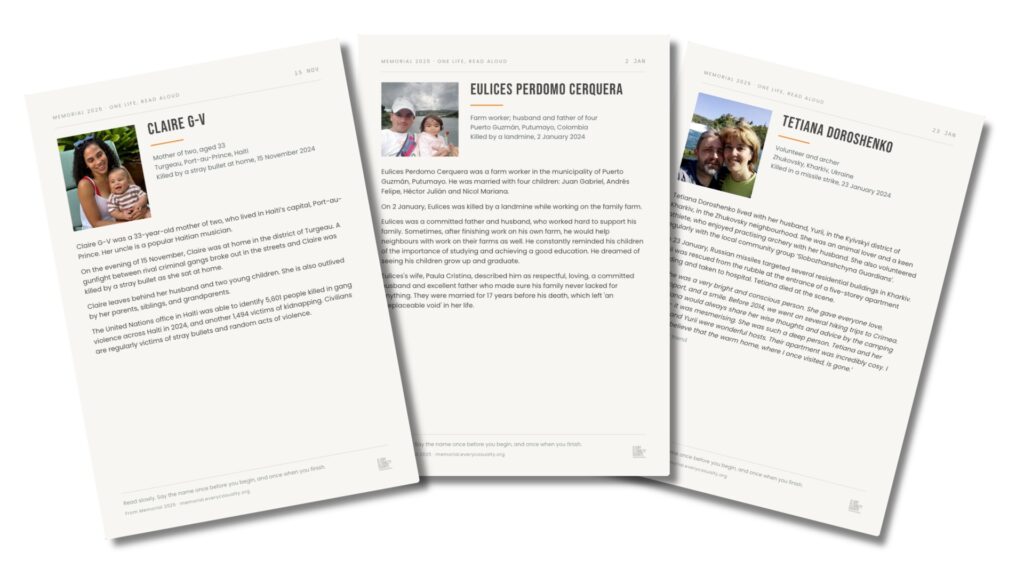
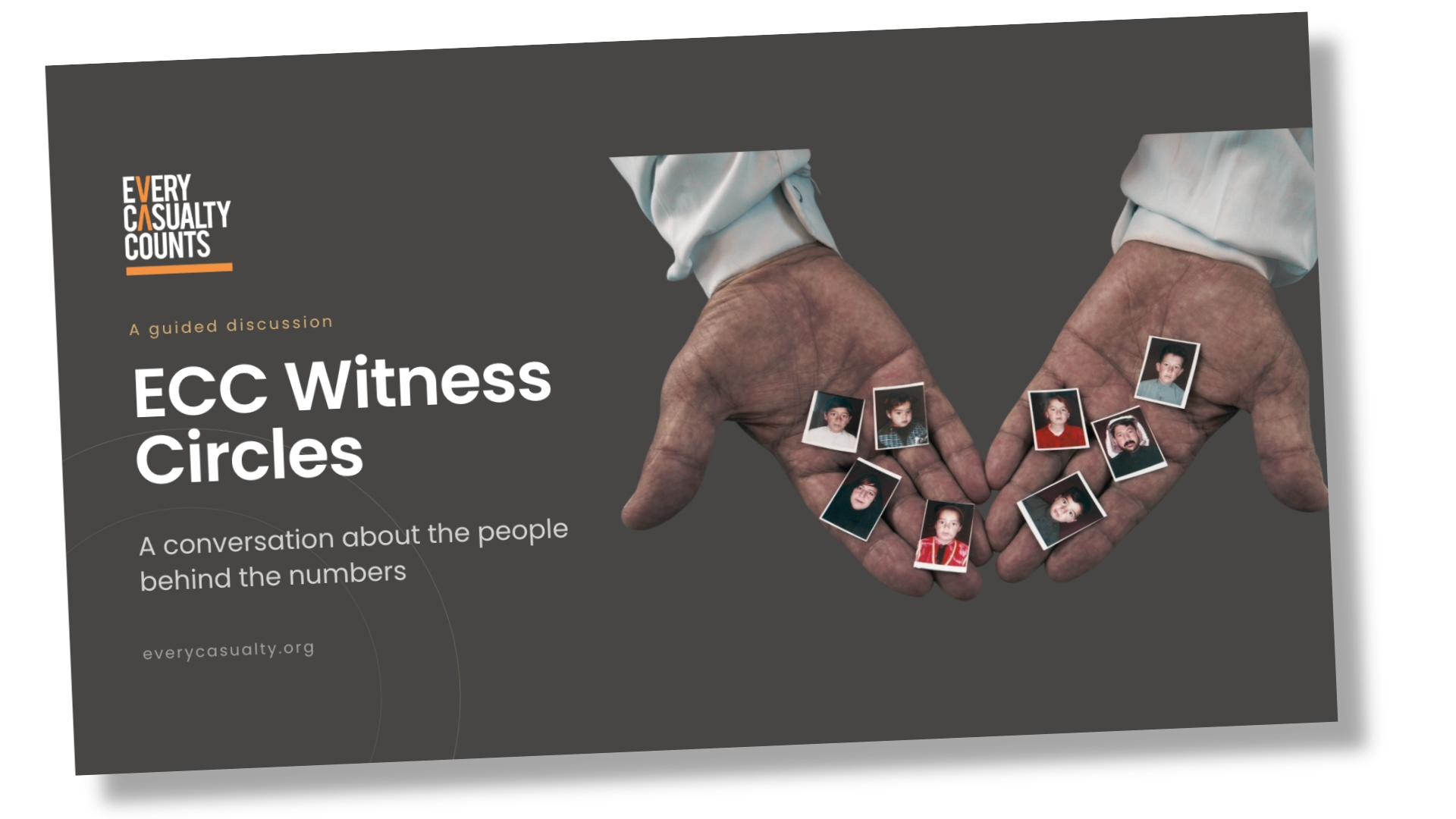
The discussion leader takes the group through a presentation about what casualty recording is and why it’s important. Group members read one person’s story from ECC’s Memorial and holds a moment of silence together. From there, a few gentle questions open up an honest conversation, not about politics or taking sides, but about why a name matters and what it asks of us to recognise lives lost far away, or “on the other side.” Circles close by reading names aloud, each marked by a small act of remembrance: a candle, a stone laid in a bowl, a minute of quiet. No one needs to be an expert, and no one needs to agree.
See what it’s like
Click the buttons below to look through a sample presentation so you can get a feel for a witness circle before you decide to host one. We have a variety of versions which are suited to different types of groups, which you can request when filling the form below.
Host a Witness Circle for your group
If you’d like to run one, fill in the form and we’ll send you everything you need: the full presentation, a short host’s guide, and simple instructions for the day. We’ll send you the edition that best suits your group.
Frequently Asked Questions
What is a Witness Circle?
A Witness Circle is a short guided conversation, around 45 minutes to an hour, that a group hosts together about the human cost of war and the work of recording it. It isn’t a lecture or a pitch. It’s a chance to sit with one simple idea: that behind every number is a person with a name, and that remembering them is something we can choose to do.
Who should run a Witness Circle?
Circles are run by volunteer hosts in all kinds of settings, a church or parish, an interfaith gathering, a u3a or community group, a peace or human rights network. Whatever your group, there’s a version made to fit it.
Do I need any special knowledge or experience to host?
No. Everything is prepared for you: the presentation, a short host’s guide, the questions, and the closing. You don’t need to be an expert on war or on ECC’s work. You bring the group and the space; we provide the rest. All you need is a screen and the know-how to share a presentation, and a printer to print the read-aloud stories of some victims of armed conflict we send you from our memorial.everycasualty.org site
What will you send me?
The full presentation, read-aloud stories of real people, a host’s guide, and simple step-by-step instructions for running the session. We’ll send you the edition that best suits your group. When you fill out the secure form below, you’ll be sent the appropriate version of the presentation for the type of group you select along with the other materials.
What kind of groups is this for?
All kinds: a church or parish, an interfaith gathering, a u3a or community group, a peace or human rights network. There are five versions so the conversation fits your group’s tradition and language, whether that’s faith-based, interfaith, or entirely secular.
Is it religious? Do we have to pray?
Only if that fits your group. The faith editions include scripture and prayer; the community and civic editions close with silence rather than prayer. You choose the version that’s right for you.
Is it political? Does it take sides?
No. ECC records every life lost to armed violence equally, whoever they were and whichever side they were on. A Witness Circle is about people and dignity, not about taking sides, and the conversation is designed to stay off politics.
How many people do we need?
A Witness Circle can be any size, we would recommend group sizes ranging from 5 to 50 people. However the materials are also suitable for larger groups, in which case the host may wish to select speakers in advance.
Can we host more than once?
Yes, and we hope you will. Many hosts bring the conversation to another group afterwards, a house group, a chaplaincy, a school, a neighbouring parish. A new edition of ECC’s Memorial is released each November, on Remembrance Sunday.
What happens after I fill in the form?
When you fill out the secure form below, you’ll be sent the appropriate version of the presentation for the type of group you select along with the other materials.
You’ll also be able to connect with a member of our staff by phone or email in case you have any questions.
Who is behind this?
Every Casualty Counts, the only global organisation focused solely on recording every life lost to armed violence, so that each person is recorded, recognised, and remembered.
Does ECC benefit from groups hosting Witness Circles?
ECC is literally the only global organisation solely dedicated to this cause, Witness Circles are one way in which we are raising public awareness of this important work. Every circle widens the number of people who know this work exists and choose to be part of it, and that is how a small organisation like ECC sustains the slow, long-term task of recording every life lost to war. Some people who take part go on to join our Remembrance Collective, sign up to our newsletter, or support the work in other ways, and that support genuinely helps. But that isn’t the point of a circle, and there’s no pressure to give. At the end of the discussion, your participants will be given the chance to find links to our website and newsletter if they wish to know more. But the real benefit, to us and to you, is simpler: more people, in more rooms, refusing to let the dead be reduced to a number.