What the dead tell us: Gaza’s demographic fingerprint
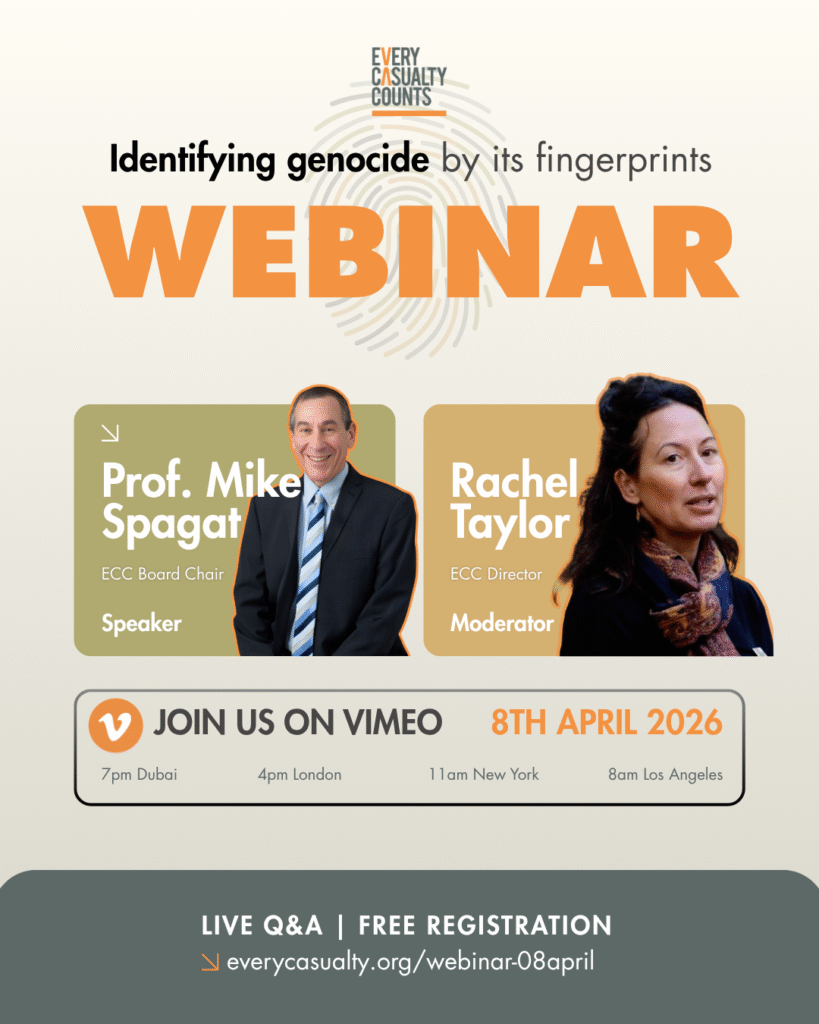
Every conflict leaves a demographic fingerprint in its casualties – who was killed, by age and sex, reflects the nature of the violence itself. Combat deaths skew young and male; some mass atrocities spread death across the full population while others, like the Srebrenica massacre, target specific demographic groups with extreme precision. A new statistical analysis by Professor Michael Spagat of more than 15 contexts uses methods for grouping conflicts with similar age-sex mortality patterns to ask a simple but powerful question: what kind of violence do Gaza’s casualty figures most resemble? The answer is striking.
REGISTER to WATCH
You will be emailed the watch link straight away
Speaker: Professor Mike Spagat, Board Chair, Every Casualty Counts:
Mike Spagat is a Professor of Economics at Royal Holloway University of London. He earned his Ph.D. at Harvard University and earlier held faculty posts at Brown University and the University of Illinois. Professor Spagat’s papers on armed conflict have been widely published, including in Nature, Scientific Reports, the New England Journal of Medicine, the Journal of Peace Research, the Journal of Conflict Resolution and PLoS Medicine. His current research addresses universal patterns in modern war, fabrication in survey research, the possible decline of war, the impact of drone strikes, civilian casualties in the Iraq and Gaza conflicts and problems in the measurement of war deaths.
Moderator: Rachel Taylor, Director, Every Casualty Counts:
Rachel has worked as a researcher and advocate in the human rights sector for over twenty years. Before joining Every Casualty Counts she was the Director of Programmes at Child Soldiers International, where she led the launch of a global database on child military exploitation. Previously Rachel was a Europe and Central Asia Researcher at Amnesty International, with responsibility for Spain, Portugal and the French-speaking countries of Western Europe. She has worked on issues ranging from asylum to torture, counter-terrorism, women’s prisons, and child soldiers. In 2018 she co-authored ‘Why 18 Matters’, which challenges the legality of the military recruitment of minors in countries including the UK and USA.
Rachel’s work has frequently focused on engaging with UN member states, human rights bodies and humanitarian agencies to seek change in international law. She has also worked directly with government ministers, security agencies and the judiciary to improve national practice in various states.